
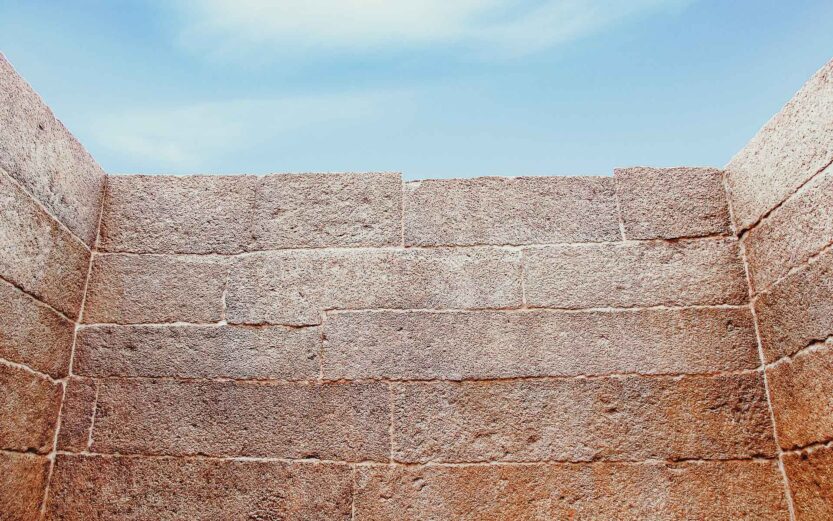
What does forbid us to travel?
Various external cirmcumstances oblige us to change our travel plans. For instance, a natural catastrophe or a war, a flight cancelled due to a strike or a pandemic, even personal or work-related reasons.
Yet, sometimes the obstacle comes from inside us, from our inner world: it is our mind.
Therefore, here we will talk about mental obstacles on a journey.
Briefly, mental obstacles and blocks are those rigid thoughts or those inibitions that force us to display a series of self-sabotaging behaviours pushing us away from our goals and desires.
Self-sabotaging is a defensive strategy we put in place to face unpleasant situations or to prevent them from happening. Often, the causes are unrealistic expectations, fear of failing or of being judged. In order to protect ourselves, we will think of us as incompetent or unworthy, we will criticize ourselves and the others, we will procrastinate and we will look in vain for perfection.
These mental obstacles make us choose certainty, predictability, repetitiveness, instead of facing the unknown.

(Adjusted picture from Pexels)
When traveling, body and mind are ingaged and interlaced. On the one hand, our body supports us exploring and moving throughout our itinerary, on the other hand, our mind gathers informations to integrate contents and create new meanings to add to our memories suitcase. However, sometimes our mind finds itself entangled in redundant thoughts, repetitive choices, worries and fears blocking our path.
Here’s the 5 most widespread mental obstacles on a journey:
When we meet someone new, how do we create a first impression? Is it based on the age, the skin colour, the gender, the ethnicity? How do we understand if they are smart or trustworthy?
Whether we like it or not, our first impressions, are guided by pre-existent expectations built on believes around the World. To us, these believes are reliable explanations that make us jump to hasty conclusions.
It happens to make a mistake! Especially, when our first impressions are influenced by stereotypes (general convinctions) and preconceptions (negative evaluations) based on fragmentary informations that craft our thoughts and feelings.
First impressions risk to obstruct our travel experience because of the dangers we expect even when there are none, of the distances we put, or the walls we build against people who just want to help us.
Mexico, for instance, is a country full of stereotypes. Before I went there, I was overwhelmed with worries and opinions. Then, first-hand, I discovered how those worries were rushed and inaccurate. Today, I suggest everyone to go to Mexico. It is a complicated country, true, but also rich in local generosity, spontaneity and tropical colours.
I tell you about this mental and inner struggle between stereotypes and reality on this post about my journey in the Yucatàn. I also recommend you reading on how to prepare your psychological suitcase before leaving for Mexico.

Playa del Carmen, Yucatan, Mexico
It is normal to build expectations, a set of predictions based on our past experiences which guide us towards the future. These predictions have an adaptive role helping us anticipate consequences and scenarios.
Waiting for the beautiful things to happen is an emotional charge that amplify and support our expectations. However, we may feel deeply deceived if the scenario we imagined does not happen.
Before leaving for a trip, we build expectations about the places we’ll see, the experiences we’ll make, the way we’ll feel once there. We read guides, watch videos and pictures or listen to stories. The whole preparation energizes us and we cannot wait to be there.
Yet, it may happen the hotel is not the same as in the picture, the place appears to be more shabby-chaotic-poor-fake-different-touristic, an attraction has been closed for a while or just for that day, or even more, we do not feel like we think we should.
Here, a post about building our travel expectations. I will talk about Bali, a mystic and fascinating land that disappointed many travellers in the last few years.

Bali and its plastic problem
Fear is one of the greatest inner obstacle in life and on a journey. It always notifies us the presence of a possible and real threat, making us feel powerless and defenceless.
The most intense and painful fear is connected to past traumas we witnessed or experienced first-hand. We are talking about natural catastrophes, aggressions, wars or the death of the loved ones. These circumstances lead to a series of specific emotional, psychological and physiological reactions – known as Post Traumatic Stress Disorder (PTSD). PTSD, in fact, deeply compromises the daily life of the affected ones, making them re-experience past traumas in the present moment.
As for travels, fear shows itself as anxious worries caused by inner signs, catastrophical predictions or traumatic events. For instance, anxiety and panic will stop us from leaving, the fear of flying or driving will influence us while traveling, worries will make us hesitant about the itineraries.
Here, you can discover how I’ve worked through a great sorrow of mine, turning it into the desire of making my life a wonderful journey.
Many travellers desire to organize the “perfect itinerary”. However, when we try to reach a too high standard compared to reality, we talk about perfectionism.
Often, perfectionism is supported by a psychological need for approval, self-validation or control. Therefore, we constantly doubt our actions, we do not tolerate uncertainty, criticism, unexpected events and mediocre results.
On a journey, perfectionism makes us inflexible, stubborn, hypercritical as well as unhappy. Trying to reach unrealistic standards makes us rigid on our itinerary, unable to embrace new encounters on our path or to turn unexpected events into new opportunities for discovery.

(Adjusted picture by Arek Socha)
The way we describe, see and perceive ourselves, influences the way we interact with the others and the World. In fact, a low self-esteem relegates us to our comfort zone, immobile, where we will feel better not trying, not risking and not exploring. All of this, because of the mistakes we may make in front of others people.
Often, a negative self-vision depends on our past experiences which made us feel inadequate and scared of taking a risk for being “inexperienced” in this World.
On a journey, our image influences every moment.
If we think “they will not like us”, we will not choose a group but solitude; when we believe “we do not deserve”, we will give up our dream journey; as we consider ourselves as “incompetent”, we will avoid most of the experiences because of the fear of failing or of making a bad impression.

Petra Tou Romio, Aphrodite Beach – Cyprus
Our mind can become the most arduous invisible obstacle we have to face traveling.
First, we have to acknowledge the inner blocks preventing us from exploring serenely the World.
Then, we have to understand how to face those obstacles. And here’s some strategies:
Let’s get closer to people, let’s travel to places and lands we have a negative opinion of, let’s take the risk of doubting and debunking the rigid thoughts that make us jump to conclusions. Often, diversities are just peculiarities that make unique places and people, and, most of the time, we may realize how similar we are.
Do we believe more in what we think or in what we see?
Let’s start finding our scale of measurement, our motivations and resolutions, and then our strong and weak spots, the sides we love about our destinations, our companions and ourselves, but also the most difficult ones.
Our goal is to leave with a “psychological suitcase” that make us dream, not idealize.
Let’s give ourselves a chance to get to listen to new sounds, to observe different ways of life, to taste local dishes and to meet people with new stories to tell. Let’s give our mind the chance to train flexibility, our emotions the chance to resonate in our body, our image the opportunity to be enriched with renewed feelings.
It will allow us to accept the discomfort caused by “changes”, to be more confident about our skills, widening our comfort zone, feeling stronger and ready to face the future.
If you feel too powerless, demoralized or frustrated by your mental blocks, but your desire is to travel with serenity in your mind, ask for a professional help through video-counseling or travel psychology with virtual reality.
So, are you ready to travel obstacles-free?
Knez, I., Butler, A., Sang, Å. O., Ångman, E., Sarlöv-Herlin, I., & Åkerskog, A. (2018). Before and after a natural disaster: Disruption in emotion component of place-identity and wellbeing. Journal of Environmental Psychology, 55, 11-17.
Brown, A. D., Dorfman, M. L., Marmar, C. R., & Bryant, R. A. (2012). The impact of perceived self-efficacy on mental time travel and social problem solving. Consciousness and Cognition, 21(1), 299-306.

Una psicologa con la valigia sempre in mano.
Benvenuti nel blog di Psicologia del viaggio.
Una psicologa con la valigia sempre in mano.
Benvenuti nel blog di Psicologia del viaggio.
© 2020 - Travelpsych. Tutti i diritti riservati.travelpsych.world - chiara@travelpsych.worldPrivacy Policy - Cookie Policy
Design by A Digital Else.
![[La diversità come pratica quotidiana]
Viaggiare è un elogio alla diversità.
•
Le differenze fanno paura e viaggiare insegna ad avvicinarci, a conoscere quei timori, a scoprire che quelle differenze non sono poi così pericolose, bensì fonte di confronto e di crescita.
•
Perché quando viaggiamo siamo noi “i diversi“: ci ritroviamo immersi in un altro Mondo fatto di altri colori, altri comportamenti, altre regole, altre lingue, altri abiti. E ci ritroviamo ad ascoltare le nostre paure, ad affrontare quelle differenze, a cercare di comprendere quella diversità.
•
Perché solo quando la nostra visione si scontra con quella di un’altra persona possiamo accorgerci di quanto il nostro modo di pensare e di vivere sia limitato e specifico ad un piccolo contesto.
Tanto piccolo.
Mentre il Mondo è grande.
Tanto grande.
.
Penso che dovremmo praticare la diversità ogni giorno 🌏
#empathy #empatia #elogioalladiversità #carlrogers #travelpsychology #quoteoftheday #psicologiadelviaggio #psicologiapositiva #frasichefannobene #empowermentquotes](https://travelpsych.world/wp-content/plugins/instagram-feed/img/placeholder.png)